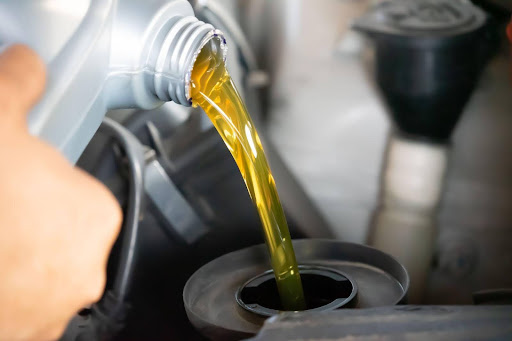
A lubricant is used to reduce friction and wear between the two surfaces in relative motion to each other. Lubricants help to improve the life of machinery. There are different types of lubricants, including dry/solid, liquid, semi-solid, and gaseous.
Different types of lubricants are available as dry lube and wet lube. A dry lube consists of an alcohol and a lubricant, and when applied, the alcohol evaporates, leaving a dry coating of the lubricant on the surface. A wet lube consists of oil and leaves a wet coating on the surface.
Dry lubes do not pick up dirt and dust, but have to be applied often. The surface remains dry, clean and non-sticky. The wet lubes tend to attract more dirt but last longer. A dry lube needs to evaporate and therefore has to be applied a few hours before use. Whereas a wet lube can be applied and used.
Some of the dry lubricants are Tungsten disulfide (WS2), Hexagonal boron nitride (hBN) and Molybdenum disulfide (MoS2). They can be used in powder form or as sprays to reduce friction and wear between two moving surfaces. A dry lube can be used in a wide temperature range, from cryogenic to high temperatures. It can be evaporated at room temperature. It is available as a convenient aerosol spray, and you can easily buy dry lube online.
Uses of dry lube
- A dry lube can be used for lubricating dry surfaces such as window hardware, electronic switches and more.
- It can be used for lubricating bearings, gears, gaskets, drive belts, chain drives, leather, plastics and sleeves.
- It can be used with cable made from natural or synthetic fibre, metals, fabric, cord, twine and rope.
- It can be used for lubricating machine parts like nuts and bolts, power saws, blades, locks, electrical equipment and more.
- It can be used for lubricating musical instruments, magnetic recording tapes, and others.
- It can be used to lubricate door hinges, window guides, locks, furniture cabinets and drawers and other household items.
- It can be used as a release agent in the moulding of rubber and plastic parts. It does not damage the moulded part, and post-finishing is not required.
Types of dry lubricants
Tungsten Disulfide (WS2)
It is classified as a Transition Metal Dichalcogenide (TMD) and possesses good tribological properties. In its layer, a plane of Tungsten atoms is sandwiched between two planes of Sulphur atoms, creating an S-W-S unit. The atoms within the layers are bonded with covalent bonds. The layers are held together by weak Van der Waals forces. When a force is applied, the layers easily glide past each other, resulting in a low coefficient of friction.
WS2 can provide lubrication in a temperature range of -273 °C to 425 °C in air and up to 1316 °C in vacuum. It is chemically inert and can be used in harsh conditions. It can provide resistance against wear and corrosion. It can be used in high-pressure and high-load applications.
Hexagonal Boron Nitride (hBN)
It is the most stable form of Boron Nitride (BN) and has a layered structure similar to Graphite. hBN is also known as ‘White Graphite’. It has a layered crystal structure consisting of hexagonal atomic layers. Within each layer, Boron and Nitrogen atoms are bonded covalently. The different layers are held together by weak Van der Waals forces. The layers easily slide past one another when a force is applied. This leads to a low coefficient of friction.
It can withstand high temperatures and has a melting point of 3000 °C. It has exceptional thermal stability, high conductivity, electrical insulating properties and chemical inertness. It can be used as a lubricant for high-temperature applications. It is non-toxic and is a preferred lubricant where the cleanliness of the environment is the main concern. It is environmentally friendly and is called a ‘Clean’ lubricant.
Molybdenum Disulfide (MoS2)
It is classified as a Transition Metal Dichalcogenide (TMD) and has a layered crystal structure. In its layer, a plane of Molybdenum atoms is sandwiched between two planes of Sulphur atoms, creating a S-Mo-S unit. The atoms within the layers are bonded with covalent bonds. The different layers are held together by weak Van der Waals forces. The layers can easily glide against each other when a force is applied. This gives MoS2 excellent lubricating properties.
It is chemically inert and has excellent thermal stability and high wear resistance. It can be used to provide lubrication in high-temperature, high-pressure and high-load conditions. It can work in a temperature range of -185 °C to 350 °C.

