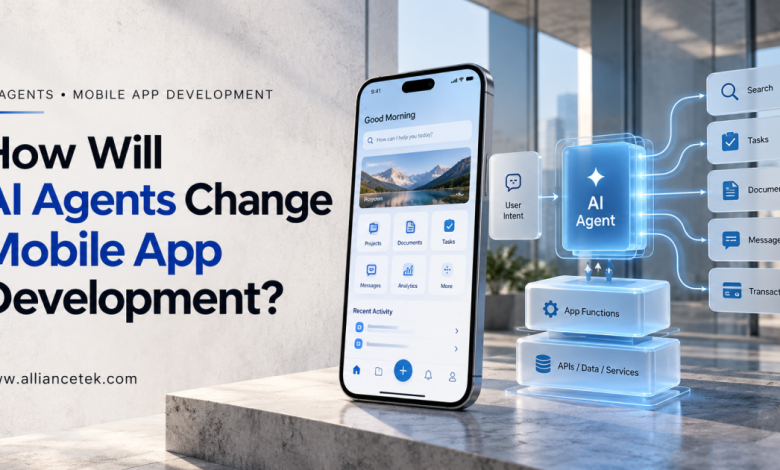
Mobile applications have traditionally been designed around screens, menus, buttons, and step-by-step user interactions. Users open an app, navigate to a feature, enter information, and complete an action. AI agents are beginning to change this model by allowing users to describe what they want and letting intelligent systems determine how to complete the task.
Recent developments in Android show where this shift is heading. Google is enabling apps to expose specific capabilities to AI agents through AppFunctions, allowing agents and assistants to discover and execute app functionality. This means users can increasingly interact with an AI assistant instead of manually navigating through every screen.
As AI agents become more capable, mobile app development will need to evolve from building applications that users operate manually to building applications whose capabilities can also be understood and orchestrated by intelligent systems.
What Are AI Agents in Mobile App Development?
AI agents are software systems that can understand user intent, reason about a task, use available tools or application functions, and take actions to accomplish a goal.
In a mobile environment, an AI agent could help a user perform multiple actions without requiring them to navigate through an application manually.
For example, instead of opening a travel app, searching for flights, checking hotels, and creating an itinerary separately, a user could ask an AI assistant to plan a trip based on their preferences. The agent could interact with the relevant application capabilities and return the required information.
This does not necessarily mean traditional mobile interfaces will disappear. Instead, AI agents can become another interaction layer alongside the existing interface.
1. Mobile Apps Will Become More Task-Oriented
One of the biggest changes will be the shift from feature-oriented apps to task-oriented experiences.
Traditional mobile development often focuses on questions such as:
- What screens should the app contain?
- Which buttons should users select?
- How should navigation work?
- How many steps are required to complete an action?
With AI agents, developers also need to consider:
- What tasks can an AI agent perform?
- Which application functions should be exposed to agents?
- What information does an agent need?
- What actions require user approval?
- How can the agent safely complete multi-step workflows?
This changes the way developers think about application functionality. Instead of designing only for human interaction, developers will increasingly design application capabilities that can be invoked by intelligent systems.
2. Natural Language Will Become a New Mobile Interface
Mobile apps have already adopted voice search, chat interfaces, and conversational assistants. AI agents can take this further by allowing users to express complex intentions in natural language.
For example, instead of manually changing several settings in an application, a user could say:
“Find my recent project documents, summarize the important updates, and prepare a message for the team.”
An agent could potentially interpret the request, identify the appropriate application functions, retrieve relevant information, and complete approved actions.
Android’s AppFunctions initiative illustrates this direction by allowing apps to expose functions that agents and assistants can discover and execute.
3. App Functionality Will Become More Accessible to AI Agents
Developers will increasingly need to make important application capabilities accessible through structured functions and APIs.
This could include capabilities such as:
- Searching customer records
- Creating appointments
- Updating orders
- Processing approved transactions
- Finding documents
- Managing tasks
- Sending messages
- Updating profiles
- Generating reports
The underlying business logic becomes particularly important. If an application’s functionality is tightly coupled to its user interface, exposing that functionality to agents can be difficult.
This means future-ready mobile architecture should separate business capabilities from presentation layers and make important functions reusable, secure, and clearly defined.
4. Personalization Will Become More Intelligent
AI agents can make mobile applications more personalized by understanding context, preferences, history, and user intent.
A traditional application might recommend products based on predefined rules or past activity. An AI agent could potentially combine multiple signals to understand what the user is trying to accomplish and adjust its actions accordingly.
For example, a fitness application could move beyond displaying activity statistics. An agent could analyze a user’s recent activity, identify changes in their routine, and help create an appropriate schedule.
Similarly, an enterprise application could help employees summarize information, identify priorities, or complete repetitive administrative tasks.
The objective is not simply to add a chatbot. It is to make the application more responsive to the user’s broader goal.
5. On-Device AI Will Become More Important
Not every AI operation needs to happen in the cloud.
On-device AI allows certain processing tasks to run directly on smartphones, which can improve privacy, reduce latency, and provide functionality when connectivity is limited. Google’s recent Android development guidance highlights on-device inference as a way to process data locally while reducing dependence on cloud inference.
For mobile applications, this can be particularly valuable for:
- Personal data processing
- Text summarization
- Classification
- Smart recommendations
- Offline assistance
- Contextual interactions
- Privacy-sensitive functionality
Developers will therefore need to decide which workloads should run on-device, in the cloud, or through a hybrid architecture.
6. Mobile App Architecture Will Need to Evolve
AI agents will introduce new architectural considerations for mobile development.
A future-ready application may need:
- Mobile interface: The traditional screens and user experience.
- AI layer: Models and intelligence responsible for understanding requests and generating responses.
- Agent orchestration: Logic that determines which functions or tools should be used.
- Application functions: Well-defined capabilities that agents can securely invoke.
- Backend services: APIs, databases, enterprise systems, and other services required to complete tasks.
- Security and permissions: Controls that determine what an agent can access and what actions require approval.
This architecture makes application capabilities easier to reuse across traditional interfaces, AI assistants, and agent-driven workflows.
7. Security and User Control Will Become Critical
Giving an AI agent the ability to perform actions creates new security considerations.
An agent that can read information is different from an agent that can modify records or initiate transactions. Developers therefore need clear permission models and action boundaries.
Important considerations include:
- Authentication and authorization
- Least-privilege access
- Sensitive data protection
- User approval for high-risk actions
- Audit logs
- Agent identity
- Input validation
- Monitoring and anomaly detection
- Protection against prompt injection and unauthorized actions
Security cannot be treated as an additional feature after the agent has been developed. It needs to be incorporated into the architecture from the beginning.
This is especially important because recent security research has demonstrated that vulnerabilities in AI-agent frameworks can potentially allow unauthorized actions when agent inputs and execution pathways are not properly protected.
8. AI Agents Will Change Mobile App Testing
AI agents will also influence how mobile applications are tested.
Traditional testing focuses on predefined scenarios and expected user interactions. Agent-based applications introduce more variable inputs because users may express the same objective in many different ways.
Testing will therefore need to evaluate:
- Natural-language requests
- Agent decision-making
- Tool and function selection
- Permission handling
- Multi-step workflows
- Failure recovery
- Incorrect or ambiguous instructions
- Security boundaries
- Human approval mechanisms
AI can also assist developers and QA teams by generating test cases, identifying potential issues, and automating repetitive testing workflows.
Recent mobile development practices already show developers experimenting with AI agents for code generation and automated UI testing, although human review remains important.
9. Developers Will Build for Both Users and Agents
Perhaps the biggest change is that developers will no longer design exclusively for human users.
A mobile application may have two audiences:
- Human users, who interact through screens, gestures, voice, and traditional interfaces.
- AI agents, which interact with application capabilities through structured functions, APIs, or platform-level integrations.
This means developers will need to think about whether application functionality is understandable, discoverable, callable, and safe for agents.
The recent move toward agent-to-app interaction suggests that application architecture may become as important as interface design in determining how well an app participates in future AI ecosystems.
Preparing Mobile Apps for the Agentic Future
Businesses planning new mobile applications should consider AI-agent readiness during the architecture stage rather than treating agents as a feature added later.
A practical approach includes:
- Identify repetitive and multi-step user tasks.
- Separate business logic from the user interface.
- Build reusable APIs and application functions.
- Define clear permissions for AI-driven actions.
- Protect sensitive information with strong access controls.
- Determine which AI workloads should run on-device or in the cloud.
- Add monitoring and audit capabilities.
- Design human approval into high-risk workflows.
- Test agent interactions alongside traditional user journeys.
Not every application needs an autonomous agent. The right approach depends on the application’s users, data, business processes, and risk profile.
The Future of Mobile App Development With AI Agents
AI agents are moving mobile applications toward a more intent-driven model. Instead of requiring users to understand where a feature is located and how to operate it, applications can increasingly expose capabilities that intelligent systems can use to accomplish user goals.
The shift is already visible in mobile platforms. Android is developing mechanisms such as AppFunctions to connect application capabilities with agents and assistants, while on-device AI is expanding the ability to deliver intelligent experiences directly on smartphones.
For mobile app developers, this does not mean abandoning traditional UI design. It means building applications that can support multiple forms of interaction.
The most successful mobile applications of the coming years may not simply be the ones with the most AI features. They may be the ones with well-designed business capabilities, strong security, intelligent automation, and architectures that allow both people and AI agents to accomplish tasks effectively.
As AI agents become a more common part of mobile experiences, businesses that prepare their applications for agent-driven interactions can create more natural, personalized, and efficient digital experiences.

